
Rotobrush Air Duct Cleaning in Lakewood: A Homeowner’s Guide
When a contractor says they use Rotobrush equipment, they’re describing a camera-guided, brush-and-vacuum system that agitates and extracts simultaneously inside the duct, which is meaningfully different from a contractor who just runs a brush through the duct and vacuums separately at the register. That difference is the whole point of this guide. Most homeowners in Lakewood never get to see what actually happens inside their ductwork, so a contractor’s tool list becomes the only real evidence of how the job is done. If you’d rather have a professional take a look than investigate on your own, call (844) 759-1418 for a free estimate.
Key Takeaways
- Rotobrush combines a rotating brush head with integrated vacuum extraction and camera guidance in a single tool.
- It performs best on flexible duct and branch runs, which are common in newer Lakewood homes.
- It has real limits on large-diameter trunk lines and damaged corrugated flex duct, and honest contractors say so.
- The camera footage is yours to review, and knowing what clean versus residual buildup looks like helps you judge the work.
- Rotobrush usually runs as one part of a combined system: mechanical agitation plus negative-pressure extraction, not a standalone job.
What is Rotobrush air duct cleaning, and how does the tool actually work?
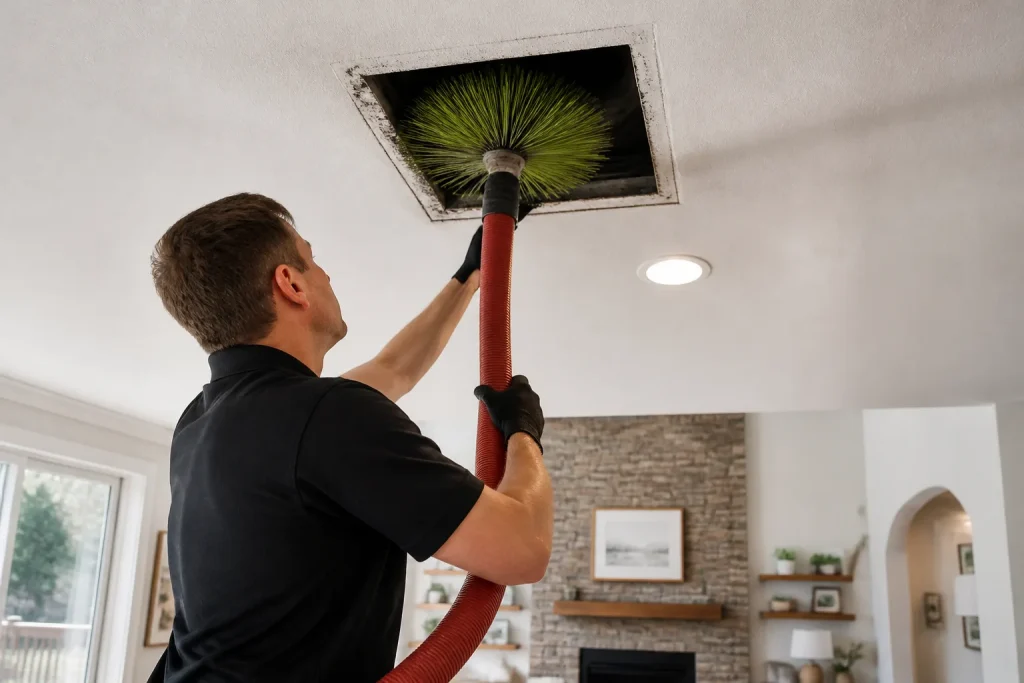
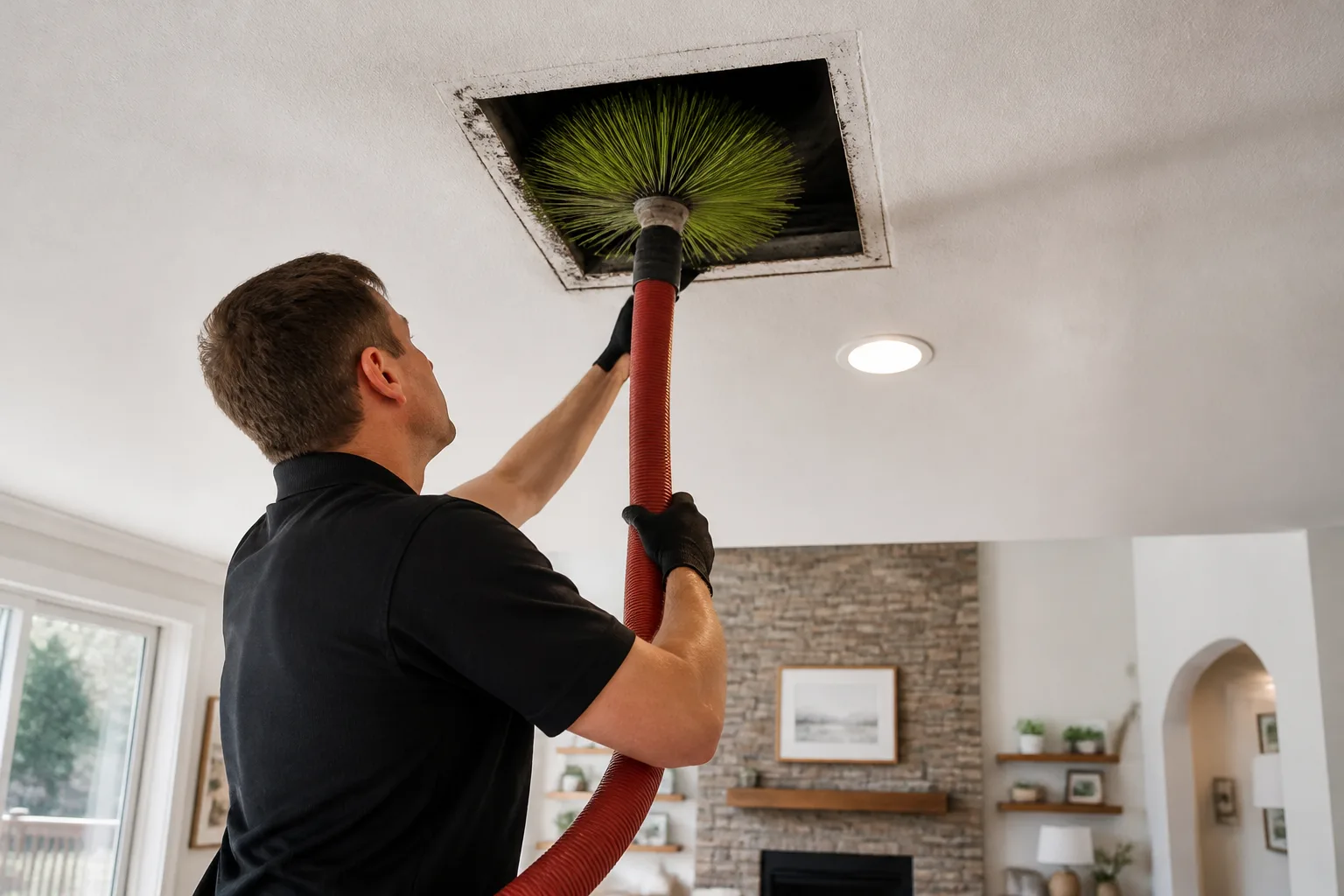
Rotobrush is a mechanical cleaning system built around a rotating brush that’s attached to a flexible shaft, pushed through the duct from an access opening, and paired with a vacuum that captures debris at the same point the brush dislodges it. The brush head spins against the duct wall to break loose settled dust, and the vacuum pulls that material out before it can drift back into your living space. On many setups, the tool also carries a small camera so the technician can watch the cleaning happen on a monitor in real time.
The word “simultaneously” matters here. A lot of cheap cleaning involves blowing compressed air through the system and hoping the debris exits somewhere, which can push contamination into other branches or stir it into the air. Rotobrush isn’t that. The brush only works where the vacuum is actively pulling, so what gets loosened gets captured, not recirculated. That’s the same principle behind the Nikro HEPA vacuum systems we run alongside it, which trap fine dust at the source rather than letting it settle back into the rooms you actually live in.
When you watch a Rotobrush job, here’s what you should be able to see and verify:
- A flexible shaft and brush head actually entering the duct, not just a hose waving at the register.
- A live camera feed on a monitor showing the inside of the duct as the brush moves through it.
- Continuous vacuum running the entire time the brush is turning.
- Before-and-after footage of the same section of duct, so you can compare conditions yourself.
If a contractor can’t show you those four things, they aren’t using Rotobrush as designed. In our experience, the tool is only as good as the operator using it, and Lakewood homeowners deserve to see the evidence, not just hear the brand name.
Where does Rotobrush perform best in Lakewood duct systems?
Rotobrush shines on flexible duct systems and branch runs, because the brush and shaft are built to travel through bends and short runs that stiffer tools can’t reach. In newer Lakewood homes, a lot of the ductwork is exactly that: insulated flex duct feeding individual rooms off a central system, often in tight attic and crawl spaces. The rotary brush conforms to the inside of flex duct well enough to scrub the walls, and the camera lets the technician confirm the whole run got attention rather than just the first few feet.
It also earns its place when documentation matters. If you’re a property manager or a homeowner who wants proof of condition, the camera-guided nature of the tool means the work is inherently recordable. You can review footage of the same duct section before and after, which turns “we cleaned it” into something you can actually check. That’s meaningful for anyone managing a rental or documenting a move-in condition, and it’s one reason we lean on Rotobrush as part of the broader air duct cleaning work we do across Lakewood.
The other sweet spot is drywall dust, construction debris, and light-to-moderate buildup after a remodel. Rotobrush handles that kind of particulate with less mess and less risk of pushing dust into adjacent rooms than air-only methods.
Where does Rotobrush fall short on older Lakewood homes?
Rotobrush is not a universal tool, and any contractor who tells you otherwise is overselling. Here’s where it has genuine limitations:
- Large-diameter horizontal trunk lines. The brush head and shaft are sized for residential branch runs. A big rectangular or oversized trunk can be wider than the tool can meaningfully scrub, and those spans often need different equipment and a larger vacuum source.
- Heavily corrugated flex duct in poor condition. If flex duct has been crushed, torn, or is sagging, pushing a spinning brush into it can make damage worse. The right answer is often to repair or replace that section, not to clean it.
- Sharp metal crimps and tight transitions. The flexible shaft can bind or stall at sharp crimps and narrow metal transitions. A technician who keeps forcing the tool through these spots isn’t being thorough, which is also why in our experience you want someone who can diagnose the layout before committing to a plan.
That’s where duct repair and sealing becomes part of the same conversation rather than a separate upsell. If a run is damaged or poorly connected, cleaning it is throwing effort at the wrong problem. Older metal trunk-and-branch systems in Lakewood often fall into this category, and honesty about that difference is a good test of the contractor you’re talking to.
How to read Rotobrush camera footage from your own duct cleaning
The camera footage is your best evidence, so it’s worth knowing what you’re looking at. Here’s a plain-language decoder for what shows up on the monitor.
- Clean duct. Even, uniform interior surface. The metal or flex liner reflects light consistently, with no patches of shadowed buildup. This is what a finished run should look like.
- Residual buildup. Gray or brownish film clinging to the wall, especially in the corners and along seams. Light residual after cleaning is normal on old systems; heavy caked-on buildup is not, and it’s a signal the run needed more work or wasn’t fully reached.
- Mold staining. Dark spots or patches, often near supply registers or in humid stretches of duct. Staining looks different from dust: it’s discoloration into the surface rather than a layer sitting on top. Staining warrants a conversation about why moisture is getting in.
- Mechanical damage. Torn flex liner, separated joints, crushed sections, or gaps at connections. This is a repair conversation, not a cleaning conversation.
Ask your contractor to walk you through the footage at the end of the job. A good technician will point out the sections that came clean, the ones that need monitoring, and the ones that need repair, using the same HEPA-extraction documentation standards they’d use on a commercial or restoration job. If the footage is a blurry thirty-second clip with no explanation, you’re not getting documentation, you’re getting a sales artifact.
Why is Rotobrush usually combined with negative-pressure extraction?
Rotobrush is typically one component of a combined cleaning system, not a standalone method. The full approach pairs mechanical agitation with a high-volume vacuum and negative-pressure setup that keeps the entire duct system under suction while the brush works each run. The vacuum source pulls from a single collection point, so loosened debris travels toward that point instead of drifting into your bedrooms. The brush does the scrubbing, the negative pressure does the capture, and the camera confirms both.
This matters when you’re comparing quotes, because a very low price usually signals that one of these pieces is missing. If a contractor quotes a number well below everyone else, ask two questions:
- “Are you using a rotary brush with integrated vacuum, or are you blowing air through?”
- “Is the whole system under negative pressure the entire time, or is that only hooked up at the end?”
A contractor using Rotobrush correctly will answer both without hesitation, and they’ll typically bring a separate HEPA unit like a Nikro or an Abatement Technologies filtration machine for the space itself. Those are the same contaminant-control units used in professional remediation, and their presence is a sign the operator thinks in terms of containment, not just surface cleaning. That’s part of why we treat the duct system, not just the surface, when we’re working in a Lakewood home.
When should you call a pro rather than investigating yourself?
Call a professional when you notice persistent musty odors, uneven airflow between rooms, visible dust puffing from registers when the system kicks on, or allergy symptoms that get worse indoors. Those are signs the problem is inside the ductwork, and once it’s there, the fix needs containment, not a shop vac.
Routine cleaning is worth discussing when:
- You’ve just finished a remodel or drywall job and dust has settled into the returns.
- The HVAC system is older and you don’t know when it was last cleaned.
- You’ve recently moved into a Lakewood home and want a baseline assessment.
- The dryer is taking longer than it used to, or the laundry room runs humid.
That last one is a good moment to mention related services in Lakewood. If lint is the concern, look at dryer vent cleaning, and if the whole system is due for a full service, we also handle HVAC cleaning alongside the ductwork. Coordinating those in one visit is simpler than booking separate contractors, and it means the same crew sees the entire air path at once. If you’re dealing with older ductwork that hasn’t been checked in a while, that’s the cue to call.
The Bottom Line
Rotobrush is a genuinely capable system when it’s used the way it’s designed: rotating brush, integrated vacuum, camera guidance, and negative pressure on the whole system. It’s a strong choice for flexible duct and branch runs in Lakewood homes, and it’s an honest limitation on large trunk lines and damaged flex. The homeowner’s advantage is simple. Ask what the contractor uses, watch the camera footage, and check that nothing was pushed around rather than pulled out. That’s how you know the work was actually done.
If you’re in Lakewood and need help, Lakewood Air Duct Cleaning Experts offers free estimates. Call (844) 759-1418. We answer 24/7. Fast dispatch from 7am to 7pm, Sunday through Friday. Our technicians have up to 11 years of experience, and we run the full range of equipment from Lakewood Air Duct Cleaning Experts so cleaning, repair, sealing, and filtration upgrades can happen in a single visit. Every job starts with a written estimate at one flat price per system agreed before work begins, plus before-and-after photos of your own ducts so you can verify the difference.
Frequently Asked Questions
Yes, for typical residential ductwork. Rotobrush agitates the duct walls with a rotating brush while vacuuming at the same point, so debris is captured rather than blown around. Compressed-air blowouts can push contamination into other branches or stir it into the air. Rotobrush isn’t right for every duct layout, but on flexible duct and branch runs it’s the stronger method. Call (844) 759-1418 for an exact quote, and we’ll tell you which approach fits your system.
Pricing depends on the size and layout of your system, how many runs need cleaning, and whether any repair or sealing is needed. We set a flat price per system based on a written estimate after we assess the ductwork. If another quote is dramatically lower, ask what equipment is being used and whether negative pressure is part of the job, because those two details explain most of the difference. Call (844) 759-1418 for a free estimate.
Yes. Camera documentation is one of the reasons Rotobrush is worth using, and reviewing before-and-after footage of your own duct runs should be part of the job. Ask your contractor to walk you through what came clean, where residual buildup remains, and whether any section shows staining or mechanical damage that needs repair. If you don’t get that walkthrough, ask for it. Call (844) 759-1418 if you’d like us to take a look at your system.
There’s no universal schedule, and anyone quoting a fixed interval without looking at your system is guessing. Remodels, pets, recent moves, moisture problems, and visible dust at registers all shift the timeline. Dust and odor are symptoms to act on; a quiet, well-maintained system often needs less than you’d think. If you’re unsure where your Lakewood home stands, call (844) 759-1418 and we can assess it rather than sell you a schedule.
Written by the team at Lakewood Air Duct Cleaning Experts.
Need Air Duct Cleaning Help?
Call Lakewood Air Duct Cleaning Experts - the local pro we connect you with is licensed and insured, with free written estimates in Lakewood.
(844) 759-1418